
Dastaan Journal
How to Check Artificial Jewellery Quality Before Buying (Pakistan)

Here is a number worth sitting with: in March 2026, gold hit a record Rs 563,862 per tola in Pakistan. At that price, a modest gold set costs more than many families’ monthly income — which is exactly why designer artificial jewellery has become the smart luxury choice, not a compromise.
But the artificial market has a quality canyon. On one side: well-crafted designer pieces with AAA-grade stones and proper plating that look stunning for years. On the other: pieces that tarnish in a month, shed stones by the second wear, and turn skin green. Both are sold as “premium” online.
This guide teaches you to tell them apart — in the shop, or from product photos when you buy artificial jewellery online in Pakistan.
Key takeaways
- Plating evenness first: uniform tone front AND back, no dark patches at edges.
- Foil-set kundan beats glued stones — press each stone; zero movement allowed.
- Brass base, not zinc alloy — the spec that decides plating life and skin safety.
- Check colour in daylight — indoor light hides mismatches.
- Run the 60-second in-hand checklist on every arrival.
In this guide
- 1. Plating: the first thing to check
- 2. Stone setting: foil-set vs glued
- 3. Weight and feel
- 4. Colour consistency
- 5. Closures, hinges and moving parts
- 6. Seller trust signals (for online buying)
- Red flags — walk away when you see these
- The 60-second in-hand checklist
- Frequently asked questions
1. Plating: the first thing to check
Plating is the visible surface — it decides both the look today and the lifespan.
- Evenness — hold the piece under good light and look along edges, curves and the back. Quality plating is uniform; cheap plating shows dark patches, thin spots or a slightly different tone at edges where coverage failed.
- What plating? Sellers of good pieces name it: 18K gold plating or rhodium plating (for silver-tone). Listings that say only “golden polish” or “premium finish” are hiding weak specs.
- The back test — flip the piece over. A quality maker finishes the back nearly as carefully as the front. Rough, dull or patchy backs mean corners were cut where they hoped you would not look.
- Thickness cues you can feel — properly plated pieces have a smooth, almost liquid feel. Thin plating feels slightly rough or “dry” to the fingertip.
2. Stone setting: foil-set vs glued
This is where designer pieces separate from bazaar pieces.
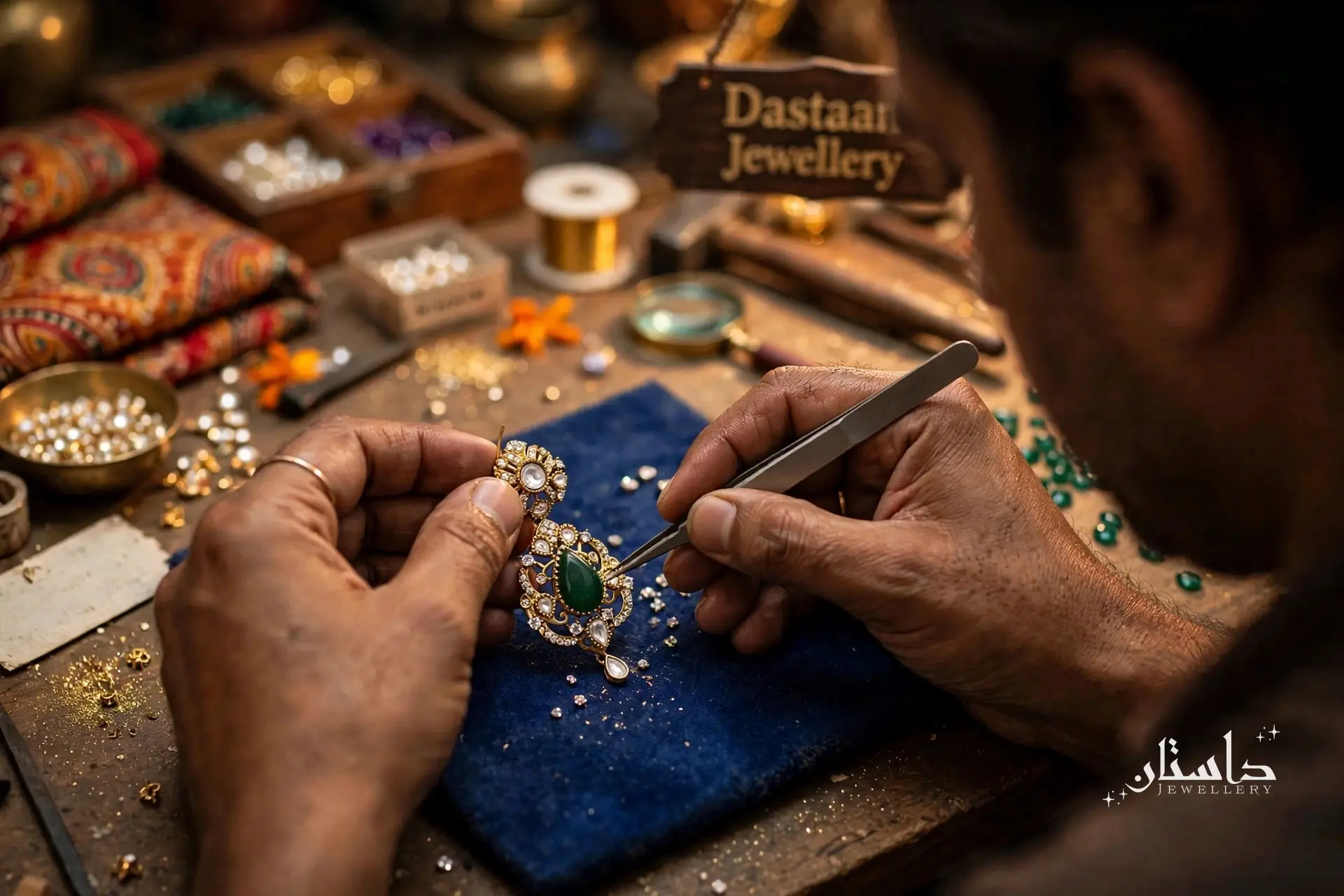
- Foil-set kundan — the traditional craft: stones set in gold foil over a wax base. Look for stones sitting level with even gaps, foil visible as a warm halo around each stone. This is the kundan comeback of 2026 — heritage craft, done right, at its most beautiful.
- Glued stones — common in cheap imitation jewellery in Pakistan. Signs: visible glue residue around stones, stones at slightly different heights, a plastic-like shine instead of depth.
- The press test — press each stone lightly with a fingertip. Nothing should shift, rock or click. On a new piece, any movement means the setting will fail within weeks.
- Prong and bezel checks — on zircon pieces, prongs should be even and smooth; on bezel-set stones, the rim should hug the stone uniformly with no gaps.
AAA-grade zircon deserves its own mention: it has sharp faceting and genuine fire — the rainbow flash you see when it moves. Lower-grade stones look bright in the product photo and glassy-flat in real life. If a seller names the grade, that is a trust signal in itself.
3. Weight and feel
Pick the piece up. Quality has a specific gravity to it.
- Brass base vs zinc alloy — this is the spec most buyers never ask about and most sellers hope you won’t. A brass base holds plating far longer, feels substantial, and rarely irritates skin. Zinc-alloy pieces feel suspiciously light, wear through plating fast, and are the usual cause of green skin marks. Ask the seller; a straight answer is a green flag, evasion is red.
- Balance — earrings should feel balanced, not head-heavy. Necklaces should drape, not pull.
- No rattles — shake gently near your ear. Any rattle means a loose component that will soon be a lost component.
4. Colour consistency
Lay the piece flat in daylight (not shop tube-light, not phone flash) and check:
- All stones of the same claimed colour should match — no odd pale or dark ones in the row.
- Metal tone should be consistent across the whole piece — clasps, chains and pendants all the same gold.
- Enamel or meenakari work should have clean colour boundaries, no bleeding between colours.
Daylight reveals what indoor lighting hides. When buying online, ask the seller for a daylight photo or short video — reputable sellers send one happily.
5. Closures, hinges and moving parts
The most common failure point in artificial jewellery is not the stones — it is the findings.
- Earring backs — butterfly backs should grip the post firmly; push-backs should click, not slide.
- Hooks — smooth, with no sharp ends that scratch the neck or ear.
- Clasps — lobster and box clasps should snap shut decisively. A clasp you have to coax is a clasp that will open in your bag.
- Hinges on bangles and cuffs — should move smoothly with no grinding, and close with a confident click.
Test every moving part before the return window closes.
6. Seller trust signals (for online buying)
When you cannot hold the piece, vet the seller instead:
- ✅ Real product photos — zoomable, multiple angles, close-ups of settings. Stock images or single blurry photos = walk away.
- ✅ Named specs — stone grade, base metal, plating type stated in the listing.
- ✅ Clear policies — exchange support, delivery timeframe, COD availability stated upfront.
- ✅ Cash on Delivery — the seller confident enough to let you pay on arrival.
- ✅ Responsive support — message a question before ordering; the speed and knowledge of the reply tells you everything.
- ✅ Reviews with photos — buyer photos in daylight are worth ten studio shots.
Red flags — walk away when you see these
- 🚩 Prices that defy physics (“90% off” on “designer” pieces) — craftsmanship has a floor cost.
- 🚩 No close-up photos, or photos that are clearly supplier stock images.
- 🚩 “Premium quality” claimed with zero named specs.
- 🚩 No exchange policy, or “sale items not returnable” as a blanket rule.
- 🚩 Advance payment only, no COD option.
- 🚩 Seller cannot answer basic questions about base metal or stone grade.
The 60-second in-hand checklist
When your parcel arrives, run this before the day ends:
- Stones — press each one; zero movement.
- Plating — even tone, front and back, no dark patches.
- Weight — feels substantial, balanced, no rattles.
- Colour — check in daylight; stones match, metal tone uniform.
- Closures — every clasp, hook and back tested twice.
Sixty seconds now saves the disappointment of a ruined outfit later.
Frequently asked questions
Is expensive artificial jewellery actually better than cheap?
Usually, yes — but price alone is not proof. A Rs 6,000 piece with named specs (AAA zircon, brass base, 18K plating) beats a Rs 6,000 piece with vague claims. Check the signals in this guide, not just the price tag.
What is the single most important quality signal?
The seller naming the base metal and stone grade. Everything else — plating life, skin safety, stone longevity — flows from those two specs. “Brass base, AAA-grade zircon, 18K gold plating” is the sentence you want to see.
Why does some artificial jewellery turn skin green?
Reaction between skin acids and cheap base metals, usually zinc alloy, once thin plating wears through. Brass-based pieces with proper plating do not do this.
Can I trust product photos when buying online?
Trust detailed photos: zoomable close-ups, multiple angles, daylight shots. Distrust single glossy images. And message the seller for a quick video — honest sellers oblige.
With gold at record prices, is designer artificial jewellery worth it?
At Rs 563,862 per tola, a well-chosen designer set at a fraction of that price — worn for years with proper care — is arguably the most rational luxury purchase in Pakistan right now.
Related: How to Care for Designer Jewellery · Designer Earrings Buying Guide (2026) · Designer Rings Buying Guide
💬 Questions about quality? Chat with Dastaan Jewellery on WhatsApp — +92 322 0043662